
REASON TO BELIEVE IN THE RESURRECTION OF JESUS
"And if Christ has not been raised, then our preaching is in vain and your faith is in vain." 1 Corinthians 15:14
"But in fact, Christ has been raised from the dead, the firstfruits of those who have fallen asleep." 1 Corinthians 15:20
- PASTOR Randy Eliason.
The resurrection of Jesus is the central claim upon which Christianity stands or falls as a religion to be believed and followed. Paul confronted the issue head-on in his letter to the church in Corinth. He didn’t dance around it. He admitted clearly that whether the good news which Jesus preached is real news - not fake news – depends on the question of the historical validity of the resurrection. Because the validity of Christianity hinges on its historicity and considering the fact that the resurrection of a dead man is a bona-fide miracle we ought to be willing to take the time to help those with doubts understand the evidence that makes believing in the resurrection plausible.
The reality of the resurrection provides the best explanation for the historical realities that surround its occurrence as well as the historical realities that sprang from it. Yes, I did just use the term historical realities. Both Christian and non-Christian historical scholars agree that we have much reliable historical information about Jesus and the birth of the Christian movement although they differ as to the degree of historical reliability one can ascribe to the NT literature.
Even Bart Ehrman, the most celebrated contemporary scholar who writes from a critical perspective and personally denies the historical reliability of the resurrection, wrote:
“It is a historical fact that some of Jesus’ followers came to believe that he had been raised from the dead soon after his execution. We know some of these believers by name; one of them, the apostle Paul, claims quite plainly to have seen Jesus alive after his death. Thus, for the historian, Christianity begins after the death of Jesus, not with the resurrection itself, but with the belief in the resurrection.”1
The fact that we have solid historical eyewitness accounts of the resurrection does not prove that it took place, but these key pieces of historical evidence are extremely difficult to explain if the resurrection did not occur.
The reality of the resurrection provides the best explanation for the historical realities that surround its occurrence as well as the historical realities that sprang from it. Yes, I did just use the term historical realities. Both Christian and non-Christian historical scholars agree that we have much reliable historical information about Jesus and the birth of the Christian movement although they differ as to the degree of historical reliability one can ascribe to the NT literature.
Even Bart Ehrman, the most celebrated contemporary scholar who writes from a critical perspective and personally denies the historical reliability of the resurrection, wrote:
“It is a historical fact that some of Jesus’ followers came to believe that he had been raised from the dead soon after his execution. We know some of these believers by name; one of them, the apostle Paul, claims quite plainly to have seen Jesus alive after his death. Thus, for the historian, Christianity begins after the death of Jesus, not with the resurrection itself, but with the belief in the resurrection.”1
The fact that we have solid historical eyewitness accounts of the resurrection does not prove that it took place, but these key pieces of historical evidence are extremely difficult to explain if the resurrection did not occur.

1. The resurrection narratives in the gospels do not bear the marks of a fabricated story.
There is little plausibility for this assertion that the gospels. The different details in the accounts of the Gospel writers does not undermine their credibility as genuine historical writings. The minor discrepancies in the accounts of the various gospel writers do not amount to contradictions, but they do reveal contrasting perspectives. The fact that their accounts contain differing details serves as evidence that the gospel writers were not colluding to fabricate a story. Evidence of an orchestrated attempt by multiple persons to fabricate a story is a conspicuous harmonizing of the facts, the opposite of what we find in the gospels.
Another factor that bolsters the historical credibility of the resurrection narratives in the gospels is the consistent recording that the first witnesses of the resurrection were women. The testimony of women did not carry much weight in Jesus’ day. Women were rarely allowed to provide testimony in a court of law. If the gospel writers were trying to fabricate a story to persuade their audience that the resurrection were true, they would never have recorded women as the first witnesses. That would undermine, not add credibility, to the assertion.
If the gospel writers were attempting to create a legendary Jesus’ we would expect them to have depicted him much differently than they did. One would expect them to describe Jesus with superhuman qualities and a glorious appearance, but instead he looks rather ordinary. We would also expect the gospel authors to portray themselves in a better light, but they humbly depict themselves as people who were both slow to understand and believe.
The church did not give birth to a myth of the resurrected Christ, the reality of the resurrected Christ gave birth to the church.
There is little plausibility for this assertion that the gospels. The different details in the accounts of the Gospel writers does not undermine their credibility as genuine historical writings. The minor discrepancies in the accounts of the various gospel writers do not amount to contradictions, but they do reveal contrasting perspectives. The fact that their accounts contain differing details serves as evidence that the gospel writers were not colluding to fabricate a story. Evidence of an orchestrated attempt by multiple persons to fabricate a story is a conspicuous harmonizing of the facts, the opposite of what we find in the gospels.
Another factor that bolsters the historical credibility of the resurrection narratives in the gospels is the consistent recording that the first witnesses of the resurrection were women. The testimony of women did not carry much weight in Jesus’ day. Women were rarely allowed to provide testimony in a court of law. If the gospel writers were trying to fabricate a story to persuade their audience that the resurrection were true, they would never have recorded women as the first witnesses. That would undermine, not add credibility, to the assertion.
If the gospel writers were attempting to create a legendary Jesus’ we would expect them to have depicted him much differently than they did. One would expect them to describe Jesus with superhuman qualities and a glorious appearance, but instead he looks rather ordinary. We would also expect the gospel authors to portray themselves in a better light, but they humbly depict themselves as people who were both slow to understand and believe.
The church did not give birth to a myth of the resurrected Christ, the reality of the resurrected Christ gave birth to the church.
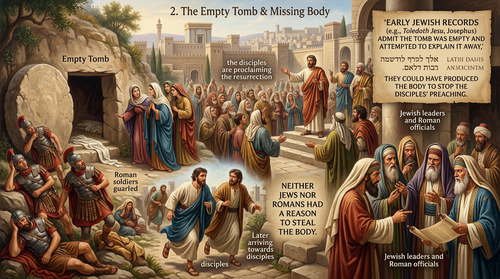
2. The Empty Tomb & Missing Body
One common suggestion made to explain why the tomb was empty and the body of Jesus was missing is that the record of the empty tomb was a historical fiction created by the New Testament authors.
However, the disciples were proclaiming the resurrection of Jesus in and around Jerusalem in a span of weeks after the resurrection, causing a stir and angering the Jewish leaders. They could have easily shut the disciples up by producing the body or pointing to the tomb that was still sealed.
Matt Perman pointing out that early Jewish arguments against the resurrection admit the tomb was empty. He writes, “The Toledoth Jesu, a compilation of early Jewish writings… acknowledges that the tomb was empty, and attempts to explain it away.” 2 Josephus, the most famous Jewish historian of the first century, wrote that Jesus was condemned and crucified, that his disciples reported that he rose again, without offering any argument to the contrary. Josephus acknowledged the report without citing any attempts to refute it.
Another second explanation which has been suggested is that the body was stolen. The problem with this theory is that neither the Jews nor Romans would have had any reason to steal the body. They had nothing to gain from an empty tomb. A dead Jesus was the only kind of Jesus that would serve their interests. The suggestion that the disciples would have - or even could have - stolen the body is incredible. Are we really to believe that the same men who were hiding out, scared for their lives, worried that they would be put to death as Jesus was, would suddenly get the courage to risk their lives and try to steal Jesus body from a heavily guarded tomb?
Gary Habermas has summed it up nicely:
“But it is precisely since Jesus' grave was located nearby that we have a serious problem if it was anything but empty. Unless Jesus' tomb was unoccupied, the early Christian preaching would have been disproved on the spot. How could it be preached that Jesus had been raised from the dead if that message were starkly confronted by a rotting body? Exposing the body
would kill the message and be an easy disproof of Christianity before it even gained momentum. Thus, Jerusalem is the last place for the early Christian teachings to gain a foothold unless Jesus' grave was empty. A Sunday walk to the tomb could have settled the matter one way or another.”3
One common suggestion made to explain why the tomb was empty and the body of Jesus was missing is that the record of the empty tomb was a historical fiction created by the New Testament authors.
However, the disciples were proclaiming the resurrection of Jesus in and around Jerusalem in a span of weeks after the resurrection, causing a stir and angering the Jewish leaders. They could have easily shut the disciples up by producing the body or pointing to the tomb that was still sealed.
Matt Perman pointing out that early Jewish arguments against the resurrection admit the tomb was empty. He writes, “The Toledoth Jesu, a compilation of early Jewish writings… acknowledges that the tomb was empty, and attempts to explain it away.” 2 Josephus, the most famous Jewish historian of the first century, wrote that Jesus was condemned and crucified, that his disciples reported that he rose again, without offering any argument to the contrary. Josephus acknowledged the report without citing any attempts to refute it.
Another second explanation which has been suggested is that the body was stolen. The problem with this theory is that neither the Jews nor Romans would have had any reason to steal the body. They had nothing to gain from an empty tomb. A dead Jesus was the only kind of Jesus that would serve their interests. The suggestion that the disciples would have - or even could have - stolen the body is incredible. Are we really to believe that the same men who were hiding out, scared for their lives, worried that they would be put to death as Jesus was, would suddenly get the courage to risk their lives and try to steal Jesus body from a heavily guarded tomb?
Gary Habermas has summed it up nicely:
“But it is precisely since Jesus' grave was located nearby that we have a serious problem if it was anything but empty. Unless Jesus' tomb was unoccupied, the early Christian preaching would have been disproved on the spot. How could it be preached that Jesus had been raised from the dead if that message were starkly confronted by a rotting body? Exposing the body
would kill the message and be an easy disproof of Christianity before it even gained momentum. Thus, Jerusalem is the last place for the early Christian teachings to gain a foothold unless Jesus' grave was empty. A Sunday walk to the tomb could have settled the matter one way or another.”3
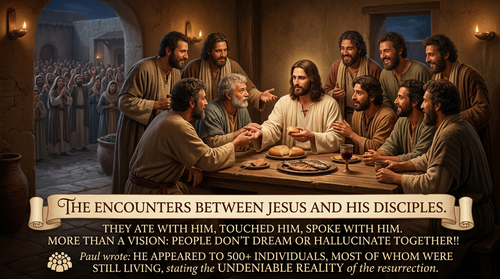
3. The Encounters Between Jesus and His disciples.
Some people speak about the appearances of Jesus, but they were more than appearances, they were encounters. They ate with him, touched him, spoke with him. Critics suggest they were either visions, dreams or hallucinations. That might be plausible if these were all individual encounters, but Jesus met with multiple people at a time. People don’t dream or hallucinate together!! NT Wright points out that they could have believed Jesus appeared to them in a vision, but they wouldn’t have confused that with the resurrection. Paul wrote that Jesus appeared to 500 individuals, most of whom were still living, as a means of stating the undeniable reality of the resurrection.
Some people speak about the appearances of Jesus, but they were more than appearances, they were encounters. They ate with him, touched him, spoke with him. Critics suggest they were either visions, dreams or hallucinations. That might be plausible if these were all individual encounters, but Jesus met with multiple people at a time. People don’t dream or hallucinate together!! NT Wright points out that they could have believed Jesus appeared to them in a vision, but they wouldn’t have confused that with the resurrection. Paul wrote that Jesus appeared to 500 individuals, most of whom were still living, as a means of stating the undeniable reality of the resurrection.
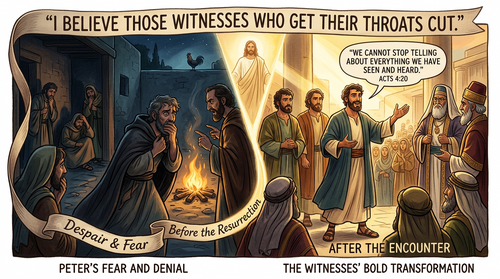
4. The Transformed Lives of the Witnesses
The French mathematician Blaise Pascal said, "I believe those witnesses who get their throats cut." It is very difficult to account for the willingness of the disciples to hold to their belief in the resurrection of Jesus even at the cost of their lives. The more plausible explanation is that they were convinced that Jesus rose again and compelled by it to no longer fear death themselves. Only a real encounter with the risen Jesus can account for the dramatic change in the countenance and courage of the disciples. Before they encountered the risen Christ following Jesus’ arrest and crucifixion were in despair and fear. Prior to Jesus’ resurrection Peter was too afraid to admit that he knew Jesus. Shortly after the resurrection we find Peter boldly telling the authorities who were threatening him to stop preaching, “We cannot stop telling about everything we have seen and heard.” (Acts 4:20)
The French mathematician Blaise Pascal said, "I believe those witnesses who get their throats cut." It is very difficult to account for the willingness of the disciples to hold to their belief in the resurrection of Jesus even at the cost of their lives. The more plausible explanation is that they were convinced that Jesus rose again and compelled by it to no longer fear death themselves. Only a real encounter with the risen Jesus can account for the dramatic change in the countenance and courage of the disciples. Before they encountered the risen Christ following Jesus’ arrest and crucifixion were in despair and fear. Prior to Jesus’ resurrection Peter was too afraid to admit that he knew Jesus. Shortly after the resurrection we find Peter boldly telling the authorities who were threatening him to stop preaching, “We cannot stop telling about everything we have seen and heard.” (Acts 4:20)
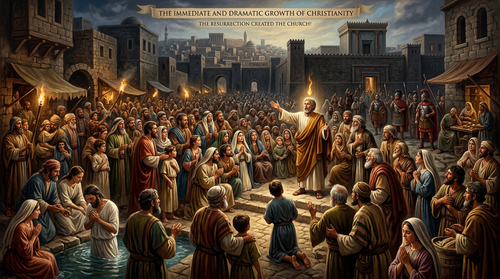
5. The Immediate and Dramatic Growth of Christianity.
Within the first 40 days of Jesus’ resurrection, we have a historical letter (1 Corinthians) referring to the fact that 500 people who were with Jesus after he rose from the dead, and that many of those were still alive and able to verify that fact. Within a couple of weeks of Jesus’ the disciples were boldly proclaiming that Jesus had risen from the dead, persuading at least 5,000, but probably closer to 10,000 people. Even more telling is the fact that these thousands of people were persuaded to the point of being willing to abandon their deeply cherished customs and traditions. It is a certainty that many more knew the message was true but simply weren’t willing to embrace a whole new way of life.
We must also take into consideration that the church grew as a persecuted minority. It had no political or cultural force fueling its growth. It grew in the face of political and cultural power structures which were opposed to it. The church was driven by people who were passionately persuaded that the resurrection was true.
Adrian Warnock writes, “The evidence for the rapid expansion of the church is compelling. No other successful movement has ever claimed its founder rose from the dead. Ultimately, the persistence and growth throughout history of the largest movement the world has ever seen is the strongest evidence for the resurrection.”4
Any honest evaluation of the history of Christianity does not lead to the conclusion that the resurrection is a myth created by the church. On the contrary, the resurrection of Jesus is what created the church!
Here are links to a couple of videos for those of you who want to dig deeper into the reasons to believe in the resurrection.
The Resurrection Argument by Gary Habermas
Did Jesus Really Rise From The Dead by NT Wright
Within the first 40 days of Jesus’ resurrection, we have a historical letter (1 Corinthians) referring to the fact that 500 people who were with Jesus after he rose from the dead, and that many of those were still alive and able to verify that fact. Within a couple of weeks of Jesus’ the disciples were boldly proclaiming that Jesus had risen from the dead, persuading at least 5,000, but probably closer to 10,000 people. Even more telling is the fact that these thousands of people were persuaded to the point of being willing to abandon their deeply cherished customs and traditions. It is a certainty that many more knew the message was true but simply weren’t willing to embrace a whole new way of life.
We must also take into consideration that the church grew as a persecuted minority. It had no political or cultural force fueling its growth. It grew in the face of political and cultural power structures which were opposed to it. The church was driven by people who were passionately persuaded that the resurrection was true.
Adrian Warnock writes, “The evidence for the rapid expansion of the church is compelling. No other successful movement has ever claimed its founder rose from the dead. Ultimately, the persistence and growth throughout history of the largest movement the world has ever seen is the strongest evidence for the resurrection.”4
Any honest evaluation of the history of Christianity does not lead to the conclusion that the resurrection is a myth created by the church. On the contrary, the resurrection of Jesus is what created the church!
Here are links to a couple of videos for those of you who want to dig deeper into the reasons to believe in the resurrection.
The Resurrection Argument by Gary Habermas
Did Jesus Really Rise From The Dead by NT Wright
------------------------------------------------------
1 Bart Ehrman, The New Testament: A Historical Introduction to the Early Christian Writings, (Third Edition New York, Oxford: Oxford University Press, 2004), 276.
2 Matt Perman, https://www.desiringgod.org/articles/historical-evidence-for-the-resurrection, Sept. 12, 2007
3 Gary Habermas, The Empty tomb of Jesus, https://www.namb.net/apologetics/resource/the-empty-tomb-of-jesus/ , March 30, 2016
4 Adrian Warnock, Resurrection: Fact or Fiction? Did Jesus Rise From The Dead? https://www.patheos.com/blogs/adrianwarnock/2024/03/resurrection-fact-or-fiction-did-jesus-rise-from-the-dead/, Nov. 5, 2025
1 Bart Ehrman, The New Testament: A Historical Introduction to the Early Christian Writings, (Third Edition New York, Oxford: Oxford University Press, 2004), 276.
2 Matt Perman, https://www.desiringgod.org/articles/historical-evidence-for-the-resurrection, Sept. 12, 2007
3 Gary Habermas, The Empty tomb of Jesus, https://www.namb.net/apologetics/resource/the-empty-tomb-of-jesus/ , March 30, 2016
4 Adrian Warnock, Resurrection: Fact or Fiction? Did Jesus Rise From The Dead? https://www.patheos.com/blogs/adrianwarnock/2024/03/resurrection-fact-or-fiction-did-jesus-rise-from-the-dead/, Nov. 5, 2025
Recent
REASON TO BELIEVE IN THE RESURRECTION OF JESUS
April 4th, 2026
Day 36: 16:1-24 ( Living Out Love in Community)
April 3rd, 2026
Day 34: 15:35-49 (The Foundation of Our Faith: The Nature of the Resurrection Body)
March 30th, 2026
Day 33: 15:12-34 (The Foundation of Our Faith: The Necessity of the Resurrection)
March 30th, 2026
Day 32: 15:1-11 (The Foundation of Our Faith: Witnesses to the Resurrection)
March 25th, 2026
Archive
2026
January
Reading Plan : 1 Corinthians Reading PlanDay 1: 1 Corinthians 1:1-9 (Greeting & Thanksgiving )Day 2: 1:10-17 (Unity in Christ, Not Division)Day 3: 1:10-17 1:18-31 (The Cross: God’s Wisdom and Power in What Seems Weak)Day 4: 2:1-9 (The Spirit Reveals God’s Wisdom and Power)Day 5: 2:10-16 (The Spirit Grants Understanding and Discernment)Day 6: 3:1-9 (Co-workers for God: Building His Church Together) Day 7: 3:10-17 (Building God’s Church: Foundation of Christ, and Holiness)Day 8: 3:18–23 (Boasting in Christ: The Foolishness of Worldly Wisdom) Day 9: 4:1-5 (Servants of Christ: Trusting God’s Judgment, Not Ours)
February
Day 10: 4:6-13 (The Apostles’ Way: Humility and Suffering)Day 11: 4:14-21 (Imitate Me: A Father’s Loving Admonition in Christ)Day 12: 5:1-13 (Loving Discipline: The Church Called to Holiness)Day 13: 6:1-11 (Disputes: God’s Wisdom in Love, Not the World’s Way)A Christian Perspective on Sexual MoralityDay 14: 6:12-20 (The Body as God’s Temple: Living in Holiness and Honoring Him)Day 15: 7:1-16 (Living Faithfully in Every Circumstance)Day 16: 7:17-24 (Living Faithfully in God’s Calling)Day 17: 7:25-40 (Living Faithfully in Every Decision)Day 18: 8:1-13 (Knowledge Guided by Love: Caring for the Weak)Day 19: 9:1-12 (Sacrificing Rights for the Gospel)Day 20: 9:19-27 (Running the Race for Christ: Discipline and Devotion)Day 21: 10:1-13 (Learning from Israel: enduring Temptation with faith)
March
Day 22: 10:14-22 (United in Christ, Separate from Idols)Day 23: 10:23-11:1 (Love Over Liberty: Living to Glorify God and Consider Others) Day 24: 11:2-16 (Honoring God's Order and Respecting Roles)Day 25: 11:17-34 (The Lord's Supper: Unity, Reverence, and Self-Examination) Day 26: 12:1-11 (One Purpose, Many Gifts: Used to Build the Church and Glorify God) Day 27: 12:12-31 (One Body, Many Parts: Unity Love in the Church)Day 28: 13:1-7 (The Characteristics of True Love)Day 29: 13:8-13 (Love Above All: The Greatest Virtue) Day 30: 14:1-25 (Spiritual Gifts That Build Up the Church in Corporate Worship)Day 31: 14:26-40 (Spiritual Gifts Practiced in Order for Corporate Worship) Day 32: 15:1-11 (The Foundation of Our Faith: Witnesses to the Resurrection)Day 33: 15:12-34 (The Foundation of Our Faith: The Necessity of the Resurrection)Day 34: 15:35-49 (The Foundation of Our Faith: The Nature of the Resurrection Body)
2025
March
Reading Plan : The Gospel of John Reading Plan1. John 1:1-18-Jesus, the Word Made Flesh(The Incarnation)2. John 1:19-28 - John the Baptist: The Forerunner of Christ3. John 1:29-34 Jesus, the Lamb of God Who Takes Away Sin4. John 1:35-51 Jesus Calls His First Disciples5. John 2:1-12 Jesus Turns Water into Wine6. John 2:13-25 Jesus, the True Temple of God7. John 3:1-21 Jesus, the Giver of Eternal Life8. John 3:22-36 Believe in Jesus, Receive Eternal Life9. John 4:1-19 Jesus, the Giver of Living Water10. John 4:20-26 Jesus Teaches True Worship11. John 4:27-42 Jesus Calls Workers for the Harvest of Souls12. John 4:43-54 Jesus Heals an Official’s Son13. John 5:1-18 Jesus Heals at the Pool of Bethesda14. John 5:19-29 Jesus, the Son Who Shares the Father’s Authority15. John 5:30-47 Jesus, The Fulfillment of Scripture16. John 6:1-21 Jesus, the Prophet (Deuteronomy 18:15)17. John 6:22-59 Jesus, the Bread of Life (Exodus 16:4, 14-15)18. John 6:41-71 Jesus, the Source of Eternal Life19. John 7:1-24 Jesus at the Feast of Tabernacles20. John 7:25-52 Jesus, the Messiah rejected by the World21. John 8:1-30 Jesus, the Light of the World22. John 8:31-59 Jesus Declares Freedom23. John 9:1-23 Jesus Heals the Man Born Blind24. John 9:24-41 Jesus, the just judge of the world25. John 10:1-21 Jesus, the Good Shepherd and the Door26. John 10:22-42 Jesus, One with the Father27. John 11:1-27 Jesus, the Resurrection and the Life28. John 11:28-44 Jesus Raises Lazarus from the Dead29. John 11:45-57 The Plot to Kill Jesus30. John 12:1-19 Jesus's Triumphal Entry
April
31. John 12:20-36 Jesus Foretells His Death32. John 12:37-50 The Unbelief of the People33. John 13:1-20 Jesus Washes the Disciples’ Feet34. John 13:21-38 Jesus Predicts His Betrayal and Peter’s Denial35. John 14:1-14 Jesus is the Way, the Truth, and the Life36. John 14:15-31 The Promise of the Holy Spirit37. John 15:1-17 Jesus, the True Vine38. John 15:18-27 Christ's followers hated by the world39. John 16:1-15 The Holy Spirit: Convicting, Guiding, and Glorifying Christ40. John 16:16-33 The Coming Victory of the Cross41. John 17:1-19 Jesus’ High Priestly Prayer42. John 17:20-26 Jesus’ Prayer for Unity Among His Followers43. John 18:1-14 Jesus’ Arrest44. John 18:15-27 Peter’s Denial of Jesusand Peter’s Denial Copy45. John 18:28-40 Jesus Before Pilate46. John 19:1-16 Jesus, the Suffering Servant Condemned47. John 19:17-30 The Crucifixion of Jesus48. John 19:31-42 Jesus’ Burial49. John 20:1-31 The Resurrection and Victory of Jesus50. John 21:1-25 Following Jesus into the World
No Comments