

A Christian Perspective on Sexual Morality
“Flee from sexual immorality. Every other sin a person commits is outside the body, but the sexually immoral person sins against his own body.” 1 Corinthians 6:18-20
- PASTOR Randy Eliason.
Louise Perry was raised in a vaguely Christian home but never read the Bible and was never exposed to Christianity in a direct way. In her own words she became “an annoying atheist” as a young teenager after reading The God Delusion by Richard Dawkins. As a young person growing up in this secular environment, Louise had little reason to question the assumptions of liberal, “sex-positive” feminism which sprang from the sexual revolution of the 1960’s.
However, her experience working in a rape crisis center began to open her eyes to issues she never noticed before. This led to a journey analyzing the conventional wisdom regarding sexual ethics which culminated in her first published book, The Case Against the Sexual Revolution: A New Guide to Sex in the 21 Century. A long-time campaigner for women’s rights, Louise Perry’s main goal in her book is to persuade her audience that adopting a consent-based sexual ethic under the guise of setting women free has, for the most part, worked against women’s interests. Perry is certainly not the first person to point out the adverse impact of the sexual revolution, but what has made her voice so compelling is that she writes from a non-religious, feminist perspective.
In an article reviewing both Perry’s book and another widely acclaimed book detailing the negative impact of the sexual revolution, Derya Little writes:
“The impact of that revolution is far-reaching, and the deterioration of marriage as a social institution is one of its most detrimental consequences. We now live in a sex-saturated society in which hook-up culture is the norm on university campuses and staying chaste until marriage is about as common as a unicorn. After sixty years, we are standing where Chesterton’s proverbial fence once stood, staring into the chaos unleashed by “free” sex.1
The confusion and chaos surrounding the subject of sexual morality is evidenced by the new language which has been introduced into the discourse of the dating scene in western cultures. It is now commonplace for people to refer to their number of sexual partners as their “body count” and discovering the “body count” of a prospective romantic partner has now become an important factor in the “get to know you” stage of forming these relationships.
On May 8, 2025, the NY Post published an article by Marissa Matozzo titled, What’s the ‘ideal’ number of sexual partners? Study reveals the sweet spot — and it’s not what you think. Matozzo writes, “A new study revealed the socially acceptable number of sexual partners for each gender — and it might surprise you. According to the study, featured in Social Psychological and Personality Science, the magic number for guys is 4 to 5 lifetime partners — with 2 to 3 of them being casual hookups. The study also revealed that a first roll in the hay for men often happens between the ages of 18 and 20. For women, the magic number shrinks to 2 to 3 partners — with only 1 to 2 casual flings.” 2
However, her experience working in a rape crisis center began to open her eyes to issues she never noticed before. This led to a journey analyzing the conventional wisdom regarding sexual ethics which culminated in her first published book, The Case Against the Sexual Revolution: A New Guide to Sex in the 21 Century. A long-time campaigner for women’s rights, Louise Perry’s main goal in her book is to persuade her audience that adopting a consent-based sexual ethic under the guise of setting women free has, for the most part, worked against women’s interests. Perry is certainly not the first person to point out the adverse impact of the sexual revolution, but what has made her voice so compelling is that she writes from a non-religious, feminist perspective.
In an article reviewing both Perry’s book and another widely acclaimed book detailing the negative impact of the sexual revolution, Derya Little writes:
“The impact of that revolution is far-reaching, and the deterioration of marriage as a social institution is one of its most detrimental consequences. We now live in a sex-saturated society in which hook-up culture is the norm on university campuses and staying chaste until marriage is about as common as a unicorn. After sixty years, we are standing where Chesterton’s proverbial fence once stood, staring into the chaos unleashed by “free” sex.1
The confusion and chaos surrounding the subject of sexual morality is evidenced by the new language which has been introduced into the discourse of the dating scene in western cultures. It is now commonplace for people to refer to their number of sexual partners as their “body count” and discovering the “body count” of a prospective romantic partner has now become an important factor in the “get to know you” stage of forming these relationships.
On May 8, 2025, the NY Post published an article by Marissa Matozzo titled, What’s the ‘ideal’ number of sexual partners? Study reveals the sweet spot — and it’s not what you think. Matozzo writes, “A new study revealed the socially acceptable number of sexual partners for each gender — and it might surprise you. According to the study, featured in Social Psychological and Personality Science, the magic number for guys is 4 to 5 lifetime partners — with 2 to 3 of them being casual hookups. The study also revealed that a first roll in the hay for men often happens between the ages of 18 and 20. For women, the magic number shrinks to 2 to 3 partners — with only 1 to 2 casual flings.” 2
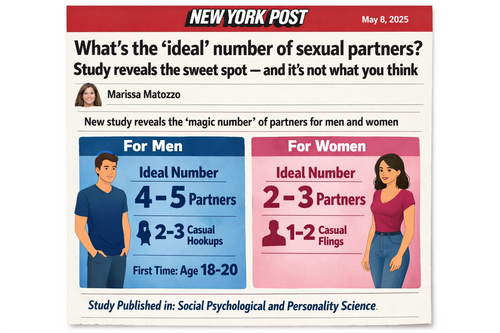
You might wonder, why are these numbers considered “ideal”? According to the author, “The reason why these numbers are described as “ideal” is what you’d probably expect -there is less judgment from society if someone (man or woman) has a low body count.”3
In other words, determining the “ideal” number of sexual partners is not arrived at by moral reasoning which appeals to human nature and human flourishing. It is far less sophisticated than that. The “ideal” is determined simply by an appeal to one’s desire for social acceptance. In response to this one might reasonably ask, “Why should the judgments of a particular social group possess the authority to define sexual morality for me?” To add to the confusion, how does one explain why the “ideal” number of sexual partners for a woman is lower than for a man? And why, as the author points out, do men get judged more for having too few sexual partners than women?
Consider the following quotes from other writers commenting on this study: “In short, moderation is hot. Too much, and you’re “too much.” Too little, and people wonder what’s wrong. Social norms haven’t totally caught up with sexual freedom, but they might be getting slightly more nuanced. Just don’t expect them to make sense anytime soon.”4
The key statement in the above quote by Ashley Fike is her word of caution against expecting our social norms to “make sense anytime soon”.
Salva Mubarak responded to the research with an opinion cautioning against treating the results as if they provide us with an objective measure that should be determinative for sexual ethics. She writes, “It’s important to note that the study had several limitations, the biggest one being that it focused on German residents only. This means that the results could differ in different societies, as cultural contexts and sexual norms could be vastly different. It also failed to capture the nuances of individual attitudes. So, take this finding with a pinch of salt and live your truth!”5 Sarah Mubarak is correct to point out that if people from different cultures were polled, the “ideal” number of sexual partners may be considered very different from this one study of people in Germany. However, her comments only serve to reinforce the notion that the appropriate (i.e. ideal) number of sexual partners is subject to a person’s cultural norm or individual preference.
In other words, determining the “ideal” number of sexual partners is not arrived at by moral reasoning which appeals to human nature and human flourishing. It is far less sophisticated than that. The “ideal” is determined simply by an appeal to one’s desire for social acceptance. In response to this one might reasonably ask, “Why should the judgments of a particular social group possess the authority to define sexual morality for me?” To add to the confusion, how does one explain why the “ideal” number of sexual partners for a woman is lower than for a man? And why, as the author points out, do men get judged more for having too few sexual partners than women?
Consider the following quotes from other writers commenting on this study: “In short, moderation is hot. Too much, and you’re “too much.” Too little, and people wonder what’s wrong. Social norms haven’t totally caught up with sexual freedom, but they might be getting slightly more nuanced. Just don’t expect them to make sense anytime soon.”4
The key statement in the above quote by Ashley Fike is her word of caution against expecting our social norms to “make sense anytime soon”.
Salva Mubarak responded to the research with an opinion cautioning against treating the results as if they provide us with an objective measure that should be determinative for sexual ethics. She writes, “It’s important to note that the study had several limitations, the biggest one being that it focused on German residents only. This means that the results could differ in different societies, as cultural contexts and sexual norms could be vastly different. It also failed to capture the nuances of individual attitudes. So, take this finding with a pinch of salt and live your truth!”5 Sarah Mubarak is correct to point out that if people from different cultures were polled, the “ideal” number of sexual partners may be considered very different from this one study of people in Germany. However, her comments only serve to reinforce the notion that the appropriate (i.e. ideal) number of sexual partners is subject to a person’s cultural norm or individual preference.

While there is clearly no consensus about the morally acceptable number of sexual partners one has, it is also clear that most people have an intuitive sense that the “ideal number” shouldn’t be “too many”. That begs the question. What counts as “too many”? The reason secular society has not arrived at a consensus about how to define “too many” sex partners is because a consensus cannot be reached when your morals are grounded in subjective moral relativism. The retreat from God’s objective standards into subjective moral relativism leads to Salva Murbarak’s lofty sounding, yet morally vacuous call to, “live your truth”. These words offer no moral wisdom and guidance. They are an expression people cling to for psychological comfort while living adrift in a sea of moral confusion and chaos.
The moral confusion within our culture is also evident in the disagreement among people regarding the ethical boundaries for initiating a sexual relationship. Under what conditions is sexual activity morally acceptable? A strong consensus has developed among proponents of the sexual revolution that the only ethical principle necessary to guide sexual conduct is mutual adult consent. However, there are some significant problems with a consent-based sexual ethic.
Just because sex is mutually consented to doesn’t mean it should have been! We often willingly engage in conduct that is not healthy for us physically, spiritually, or emotionally. Christine Emba made this rather obvious point in the Washington Post. “Nonconsensual sex is always wrong, full stop. But that doesn’t mean consensual sex is always right. Even sex that is agreed to can be harmful to an individual, their partner or to society at large.”6
In a response to the article by Christine Emba and another article which expressed a similar dissatisfaction with the consent-based sex ethic embraced by most westerners, Trevin Wax offered a challenge to Christians to seize the opportunity in front of us to demonstrate the better sex ethic taught in our scriptures. He wrote, “Neither Lewis nor Emba appear to be so radically rethinking sexual norms that they’d entertain the Christian sexual ethic. But these are baby steps, important ones, that indicate a sense of angst and anxiety underneath the commonsense cultural ethos surrounding sex. The church has an opportunity to offer a better way here, but only if our lives match our teaching.”7
What is the Better Way?
Before we can attempt to define the boundaries of morally permissible sexual behavior, we must first answer the question, “What is sex for?”
The secular answer: Sex is for whatever purpose consenting adults want it to serve.
The secular perspective does not consider life to have any sacred order or meaning to it, so we are free to assign meaning and purpose to our lives, including our sexual relationships, as we wish. As feminist author Camille Paglia expressed it: “Fate, not God, has given us this flesh. We have absolute claim to our bodies and may do with them as we see fit.”8 Paglia argues that nature is a tyrannical force which we have not only a right, but an obligation, to defy rather than a sacred order we must conform to.
God’s answer: Sex Brings Glory of God by Conforming to His Creational Purpose
The good news for those who are confused and conflicted by the contemporary consent-based sexual ethic is that there is a sacred order and meaning to the sexual function of human beings. As persons created in the image of God and redeemed by Jesus’ sacrifice, the Christian’s body belongs to the Lord and is to be used for the glory of God. In a warning to Christian men about the spiritual dangers of engaging in sex with prostitutes, Paul wrote,
Flee from sexual immorality. Every other sin a person commits is outside the body, but the sexually immoral person sins against his own body. Or do you not know that your body is a temple of the Holy Spirit within you, whom you have from God? You are not your own, for you were bought with a price. So, glorify God in your body. -1 Cor. 6:18-20
The moral confusion within our culture is also evident in the disagreement among people regarding the ethical boundaries for initiating a sexual relationship. Under what conditions is sexual activity morally acceptable? A strong consensus has developed among proponents of the sexual revolution that the only ethical principle necessary to guide sexual conduct is mutual adult consent. However, there are some significant problems with a consent-based sexual ethic.
Just because sex is mutually consented to doesn’t mean it should have been! We often willingly engage in conduct that is not healthy for us physically, spiritually, or emotionally. Christine Emba made this rather obvious point in the Washington Post. “Nonconsensual sex is always wrong, full stop. But that doesn’t mean consensual sex is always right. Even sex that is agreed to can be harmful to an individual, their partner or to society at large.”6
In a response to the article by Christine Emba and another article which expressed a similar dissatisfaction with the consent-based sex ethic embraced by most westerners, Trevin Wax offered a challenge to Christians to seize the opportunity in front of us to demonstrate the better sex ethic taught in our scriptures. He wrote, “Neither Lewis nor Emba appear to be so radically rethinking sexual norms that they’d entertain the Christian sexual ethic. But these are baby steps, important ones, that indicate a sense of angst and anxiety underneath the commonsense cultural ethos surrounding sex. The church has an opportunity to offer a better way here, but only if our lives match our teaching.”7
What is the Better Way?
Before we can attempt to define the boundaries of morally permissible sexual behavior, we must first answer the question, “What is sex for?”
The secular answer: Sex is for whatever purpose consenting adults want it to serve.
The secular perspective does not consider life to have any sacred order or meaning to it, so we are free to assign meaning and purpose to our lives, including our sexual relationships, as we wish. As feminist author Camille Paglia expressed it: “Fate, not God, has given us this flesh. We have absolute claim to our bodies and may do with them as we see fit.”8 Paglia argues that nature is a tyrannical force which we have not only a right, but an obligation, to defy rather than a sacred order we must conform to.
God’s answer: Sex Brings Glory of God by Conforming to His Creational Purpose
The good news for those who are confused and conflicted by the contemporary consent-based sexual ethic is that there is a sacred order and meaning to the sexual function of human beings. As persons created in the image of God and redeemed by Jesus’ sacrifice, the Christian’s body belongs to the Lord and is to be used for the glory of God. In a warning to Christian men about the spiritual dangers of engaging in sex with prostitutes, Paul wrote,
Flee from sexual immorality. Every other sin a person commits is outside the body, but the sexually immoral person sins against his own body. Or do you not know that your body is a temple of the Holy Spirit within you, whom you have from God? You are not your own, for you were bought with a price. So, glorify God in your body. -1 Cor. 6:18-20

A consent-based ethic is insufficient from a Christian perspective because our bodies do not belong to ourselves. Rather, they are a gift from our creator which we must steward for his glory. Consent is an insufficient criterion for sexual relations because, as God’s image bearers, we don’t have absolute claim to our bodies despite Camille Paglia’s claim. Karlo Boussard offers the following explanation: “But my consent has no legitimizing power unless the activity that I authorize is subject to my authorization. Suppose, for example, that I tell you that you have my permission to steal your neighbor’s car. My consent would not thereby give justification to the act because I don’t have the right to authorize it in the first place. Valid consent, therefore, is not valid by the mere fact of consent. It requires a preexisting right to authorize a course of action.”9
How Does Sex Glorify God? Sex glorifies God when it fulfills His two-fold creational purpose.
A. Procreation. God commanded Adam and Eve to be fruitful and multiply. The primary gift of sex is that it enables procreation, the gift of new life. Unfortunately, the sexual revolution has taught people that the purpose of sex is primarily pleasure. The problem is that procreative sex entails responsibility and commitment which often inhibit pleasure. Therefore, as pursuing sex for pleasure has become more highly valued, the reproductive function of sex has been devalued. Nancy Pearcey writes, “In a culture that says we have the right to the pleasures of sex while denying its biological function – many will end up treating babies as the enemy – intruding where they are not wanted or welcome.”10 No one should be surprised to discover an increased aversion to reproduction and the alarming decline in birth-rates following
the sexual revolution.
B. To strengthen the loving bond between husband and wife. To understand the purpose of sex you must understand the purpose of marriage. God ordained marriage to form a loving bond between a man and woman. The pleasure of sex has a bonding purpose to it. It enhances the parental bond while becoming the vehicle for creating new life! By adhering to God’s design for marriage and sex, children enjoy the benefits of being nurtured by a mother and a father who love them and each other.
How Does Sex Glorify God? Sex glorifies God when it fulfills His two-fold creational purpose.
A. Procreation. God commanded Adam and Eve to be fruitful and multiply. The primary gift of sex is that it enables procreation, the gift of new life. Unfortunately, the sexual revolution has taught people that the purpose of sex is primarily pleasure. The problem is that procreative sex entails responsibility and commitment which often inhibit pleasure. Therefore, as pursuing sex for pleasure has become more highly valued, the reproductive function of sex has been devalued. Nancy Pearcey writes, “In a culture that says we have the right to the pleasures of sex while denying its biological function – many will end up treating babies as the enemy – intruding where they are not wanted or welcome.”10 No one should be surprised to discover an increased aversion to reproduction and the alarming decline in birth-rates following
the sexual revolution.
B. To strengthen the loving bond between husband and wife. To understand the purpose of sex you must understand the purpose of marriage. God ordained marriage to form a loving bond between a man and woman. The pleasure of sex has a bonding purpose to it. It enhances the parental bond while becoming the vehicle for creating new life! By adhering to God’s design for marriage and sex, children enjoy the benefits of being nurtured by a mother and a father who love them and each other.

The sexual revolution was intended to free human beings from the traditional restraints that God’s word places on sexual expression. It has been successful at providing people with an abundance of sexual pleasure, but at a very high cost. All around us we see the harmful fallout from unhitching sex from the marriage relationship and emptying it of any higher value and purpose than physical pleasure. Peter’s warning about those who promise freedom while they are themselves slaves of corruption is strikingly applicable to the advocates of “sexual freedom”. The corrupt fruit of this “freedom” is evident in the massive number of abortions, std’s, and children being raised in unstable homes. It has led to an explosion of pornography, the most socially corrosive and de-stabilizing force in our world today. Our secular priests who serve the ‘god’ of recreational sex promised “life” through freedom from God’s “repressive restrictions” on sexual conduct, but what they delivered is a world where human bodies have been reduced to commodities for personal consumption. Sexual exploitation has become embedded in our culture.
God is not anti-sex, He is pro-love. It is for this reason, because God is pro-love, that He designed sex to be an expression of love. But here is the rub. Commitment free sex is not love because true love entails commitment. Love is commitment centric, not commitment free. Having sex and making love are not the same thing if the act is taking place outside the bounds of commitment, no matter how pleasurable the experience is. Commitment free love is an oxymoron. Until you say “I do” to commitment you haven’t said “Yes” to love. The choice to refrain from making a commitment is in effect saying “no” to love. God’s plan for sex to be expressed within the bounds of a marriage covenant is beautiful because it connects sex with love, an unconditional devotion to another’s well-being.
The procreative function of sex reveals God’s intention for sex to be an expression of love, a love which is oriented towards responsibility and commitment. To attempt to engage in sex recreationally and impersonally is to lie to ourselves. It ignores or denies our own biological design. In her book “Love Thy Body” Nancy Pearcey writes, “Scientists first learned about oxytocin because of its role in childbirth and breastfeeding. The chemical stimulates an instinct for caring and nurturing. It is often called the attachment hormone. After pointing out that oxytocin, the attachment hormone, is also released during sexual intercourse she writes, “The upshot is that even if you think you are having a no strings-attached hookup, you are in reality creating a chemical bond – whether you mean to or not.”11
God is not anti-sex, He is pro-love. It is for this reason, because God is pro-love, that He designed sex to be an expression of love. But here is the rub. Commitment free sex is not love because true love entails commitment. Love is commitment centric, not commitment free. Having sex and making love are not the same thing if the act is taking place outside the bounds of commitment, no matter how pleasurable the experience is. Commitment free love is an oxymoron. Until you say “I do” to commitment you haven’t said “Yes” to love. The choice to refrain from making a commitment is in effect saying “no” to love. God’s plan for sex to be expressed within the bounds of a marriage covenant is beautiful because it connects sex with love, an unconditional devotion to another’s well-being.
The procreative function of sex reveals God’s intention for sex to be an expression of love, a love which is oriented towards responsibility and commitment. To attempt to engage in sex recreationally and impersonally is to lie to ourselves. It ignores or denies our own biological design. In her book “Love Thy Body” Nancy Pearcey writes, “Scientists first learned about oxytocin because of its role in childbirth and breastfeeding. The chemical stimulates an instinct for caring and nurturing. It is often called the attachment hormone. After pointing out that oxytocin, the attachment hormone, is also released during sexual intercourse she writes, “The upshot is that even if you think you are having a no strings-attached hookup, you are in reality creating a chemical bond – whether you mean to or not.”11

In a rebuke of men in Corinth who were treating sex as if it was merely a means of sexual gratification devoid of any deeper sacred meaning, Paul wrote, “Or do you not know that he who is joined to a prostitute becomes one body with her? For, as it is written, “The two will become one flesh.” (1 Corinthians 6:16) Lauren Winner, alluding to these words of Paul, offers her own incisive statement about the bonding nature of sexual intercourse when she writes, “Don’t you know that when you sleep with someone your body makes a promise whether you do or not”. 12
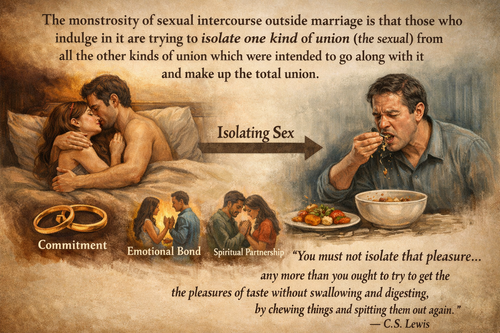
C.S. Lewis offered a perceptive warning about the danger of trying to isolate the physical act of sex from its personal bonding function. He explained it this way: “The monstrosity of sexual intercourse outside marriage is that those who indulge in it are trying to isolate one kind of union (the sexual) from all the other kinds of union which were intended to go along with it and make up the total union. The Christian attitude does not mean that there is anything wrong about sexual pleasure, any more than about the pleasure of eating. It means that you must not isolate that pleasure and try to get it by itself, any more than you ought to try to get the pleasures of taste without swallowing and digesting, by chewing things and spitting them out again.”13
C.S. Lewis offered a perceptive warning about the danger of trying to isolate the physical act of sex from its personal bonding function. He explained it this way: “The monstrosity of sexual intercourse outside marriage is that those who indulge in it are trying to isolate one kind of union (the sexual) from all the other kinds of union which were intended to go along with it and make up the total union. The Christian attitude does not mean that there is anything wrong about sexual pleasure, any more than about the pleasure of eating. It means that you must not isolate that pleasure and try to get it by itself, any more than you ought to try to get the pleasures of taste without swallowing and digesting, by chewing things and spitting them out again.”13
Conclusion:
When trying to persuade people of the beauty of Christian sexual ethic, it is important to help them see that Christians aren’t the only ones making judgments about sexual ethics. As we have seen, secular people make judgments about how many sexual partners one ought to have and about how casual or risky one ought to be when engaging in sexual activity.
The sexual revolution envisioned, and promised, a world where people would be free from the “repressive sexual moral codes” of religion to enjoy judgment free sexual gratification. However, most can’t seem to shake themselves free from making moral judgments due to their intuitive sense that sex is more than a casual act, devoid of any meaning other than physical pleasure. Those who have embraced the ‘sex-positive’ ethic in theory are finding that it doesn’t seem to work well in the real world. They are internally conflicted. On the one hand, their intuition inclines them to make moral judgments about sexual behavior, yet, on the other hand, they do not have any solid ground (i.e. moral framework) upon which to base their
judgments.
Sacred scripture (The Christian Bible) has provided the Christian with a moral framework upon which to define sexual morality. The Christian claim that sex is part of God’s good creation, designed and intended for the covenant of marriage, is consistent with nature. Science teaches us that sex is not an impersonal physical act. It involves the whole person in a deeply personal way. The biological nature of sex, with its inherent procreative and bonding functions, reveal that it is oriented towards commitment and responsibility. Because God designed the sexual function of our bodies to be oriented towards commitment and responsibility, he therefore ordained marriage – a life-long covenant of love between one man and one woman - as its proper context.

Sexual immorality violates the first and second greatest commandments, the commands to love God with all our being and our neighbor as ourselves. Sex outside the covenant of marriage violates the first commandment because it disregards God's design for sexual intimacy. It is an act of defiance against God. Sex outside the covenant of marriage violates the second great command to love people. It fails as an expression of love because it creates a physical bond, a sense of love, while denying each other the substance of love, an enduring commitment.
To treat a person as your sex partner but not your spouse is to dishonor that person, whether they feel dishonored or not. Many people, usually the female partners in these non-marital sexual relationships, do in fact feel dishonored by their partner’s refusal or reluctance to commit to them in marriage. The sense of dishonor often breeds tremendous resentment, conflict, and strife. The response of Christians to this current cultural moment must be to rise up and make disciples, young and old, who will begin a godly rebellion against the lies of the sexual revolution and return sex to the sacred space of the marriage covenant.
To treat a person as your sex partner but not your spouse is to dishonor that person, whether they feel dishonored or not. Many people, usually the female partners in these non-marital sexual relationships, do in fact feel dishonored by their partner’s refusal or reluctance to commit to them in marriage. The sense of dishonor often breeds tremendous resentment, conflict, and strife. The response of Christians to this current cultural moment must be to rise up and make disciples, young and old, who will begin a godly rebellion against the lies of the sexual revolution and return sex to the sacred space of the marriage covenant.

------------------------------------------------------
1 Derya Little, “A Tale of Two Books against the Sexual Revolution”, The Catholic World Report, March 8, 2023, https://www.catholicworldreport.com/2023/03/08/a-tale-of-two-booksagainst- the-sexual-revolution/
2 Marissa Motozzo, “What’s the ‘ideal’ number of sexual partners? Study reveals the sweet spot— and it’s not what you think”, NY Post, May 8, 2025, https://nypost.com/2025/05/08/lifestyle/is-there-an-ideal-body-count-study-reveals-asweet-spot/
3 Ibid.
4 Ashley Fike, “This Is the ‘Ideal’ Body Count. Is Yours Higher or Lower?”, Vice Magazine, June 16, 2025, https://www.vice.com/en/article/this-is-the-ideal-body-count-is-yours-higher-or-lower/
5 Sarah Mubarak, “Too Many Or Too Few Sexual Partners? This Study Has Found The Sweet Spot”, Manifest Magazine, May 12, 2025, https://www.manifestmagazine.in/trendsculture/relationships/research-on-the-ideal-number-of-sexual-partners-for-men-and-women
6 Christine Emba, “Consent is Not Enough. We need a new Sexual Ethic”, The Washington Post, March 17, 2022, https://www.washingtonpost.com/opinions/2022/03/17/sex-ethics-rethinkingconsent-culture/
7 Trevin Wax, “Why Consent Isn’t Enough for a Sexual Ethic, The Gospel Coalition, March 31, 2022 https://www.thegospelcoalition.org/blogs/trevin-wax/consent-not-enough/
8 Camille Paglia, “Rebel Love: Homosexuality,” Vamps and Tramps (New York: Vintage Books,
1994), 71
9 Karlo Broussard, “The Moral Limits of Consent”, Catholic Answers, Dec. 13, 2017,
https://www.catholic.com/magazine/online-edition/the-moral-limits-of-consent
10 Nancy Pearcey, Love Thy Body, (Baker Books, 2018), 150
11 Ibid., 127
12 Winner, Lauren W., Real Sex: The Naked Truth about Chastity. (Grand Rapids: Brazos, 2005), 88
13 Lewis, C.S. Mere Christianity, (New York, NY: HarperCollins Publishers, 2001), 104–105.
1 Derya Little, “A Tale of Two Books against the Sexual Revolution”, The Catholic World Report, March 8, 2023, https://www.catholicworldreport.com/2023/03/08/a-tale-of-two-booksagainst- the-sexual-revolution/
2 Marissa Motozzo, “What’s the ‘ideal’ number of sexual partners? Study reveals the sweet spot— and it’s not what you think”, NY Post, May 8, 2025, https://nypost.com/2025/05/08/lifestyle/is-there-an-ideal-body-count-study-reveals-asweet-spot/
3 Ibid.
4 Ashley Fike, “This Is the ‘Ideal’ Body Count. Is Yours Higher or Lower?”, Vice Magazine, June 16, 2025, https://www.vice.com/en/article/this-is-the-ideal-body-count-is-yours-higher-or-lower/
5 Sarah Mubarak, “Too Many Or Too Few Sexual Partners? This Study Has Found The Sweet Spot”, Manifest Magazine, May 12, 2025, https://www.manifestmagazine.in/trendsculture/relationships/research-on-the-ideal-number-of-sexual-partners-for-men-and-women
6 Christine Emba, “Consent is Not Enough. We need a new Sexual Ethic”, The Washington Post, March 17, 2022, https://www.washingtonpost.com/opinions/2022/03/17/sex-ethics-rethinkingconsent-culture/
7 Trevin Wax, “Why Consent Isn’t Enough for a Sexual Ethic, The Gospel Coalition, March 31, 2022 https://www.thegospelcoalition.org/blogs/trevin-wax/consent-not-enough/
8 Camille Paglia, “Rebel Love: Homosexuality,” Vamps and Tramps (New York: Vintage Books,
1994), 71
9 Karlo Broussard, “The Moral Limits of Consent”, Catholic Answers, Dec. 13, 2017,
https://www.catholic.com/magazine/online-edition/the-moral-limits-of-consent
10 Nancy Pearcey, Love Thy Body, (Baker Books, 2018), 150
11 Ibid., 127
12 Winner, Lauren W., Real Sex: The Naked Truth about Chastity. (Grand Rapids: Brazos, 2005), 88
13 Lewis, C.S. Mere Christianity, (New York, NY: HarperCollins Publishers, 2001), 104–105.
Recent
Day 32: 15:1-11 (The Foundation of Our Faith: Witnesses to the Resurrection)
March 25th, 2026
Day 31: 14:26-40 (Spiritual Gifts Practiced in Order for Corporate Worship)
March 23rd, 2026
Day 30: 14:1-25 (Spiritual Gifts That Build Up the Church in Corporate Worship)
March 20th, 2026
Day 29: 13:8-13 (Love Above All: The Greatest Virtue)
March 18th, 2026
Day 28: 13:1-7 (The Characteristics of True Love)
March 16th, 2026
Archive
2026
January
Reading Plan : 1 Corinthians Reading PlanDay 1: 1 Corinthians 1:1-9 (Greeting & Thanksgiving )Day 2: 1:10-17 (Unity in Christ, Not Division)Day 3: 1:10-17 1:18-31 (The Cross: God’s Wisdom and Power in What Seems Weak)Day 4: 2:1-9 (The Spirit Reveals God’s Wisdom and Power)Day 5: 2:10-16 (The Spirit Grants Understanding and Discernment)Day 6: 3:1-9 (Co-workers for God: Building His Church Together) Day 7: 3:10-17 (Building God’s Church: Foundation of Christ, and Holiness)Day 8: 3:18–23 (Boasting in Christ: The Foolishness of Worldly Wisdom) Day 9: 4:1-5 (Servants of Christ: Trusting God’s Judgment, Not Ours)
February
Day 10: 4:6-13 (The Apostles’ Way: Humility and Suffering)Day 11: 4:14-21 (Imitate Me: A Father’s Loving Admonition in Christ)Day 12: 5:1-13 (Loving Discipline: The Church Called to Holiness)Day 13: 6:1-11 (Disputes: God’s Wisdom in Love, Not the World’s Way)A Christian Perspective on Sexual MoralityDay 14: 6:12-20 (The Body as God’s Temple: Living in Holiness and Honoring Him)Day 15: 7:1-16 (Living Faithfully in Every Circumstance)Day 16: 7:17-24 (Living Faithfully in God’s Calling)Day 17: 7:25-40 (Living Faithfully in Every Decision)Day 18: 8:1-13 (Knowledge Guided by Love: Caring for the Weak)Day 19: 9:1-12 (Sacrificing Rights for the Gospel)Day 20: 9:19-27 (Running the Race for Christ: Discipline and Devotion)Day 21: 10:1-13 (Learning from Israel: enduring Temptation with faith)
March
Day 22: 10:14-22 (United in Christ, Separate from Idols)Day 23: 10:23-11:1 (Love Over Liberty: Living to Glorify God and Consider Others) Day 24: 11:2-16 (Honoring God's Order and Respecting Roles)Day 25: 11:17-34 (The Lord's Supper: Unity, Reverence, and Self-Examination) Day 26: 12:1-11 (One Purpose, Many Gifts: Used to Build the Church and Glorify God) Day 27: 12:12-31 (One Body, Many Parts: Unity Love in the Church)Day 28: 13:1-7 (The Characteristics of True Love)Day 29: 13:8-13 (Love Above All: The Greatest Virtue) Day 30: 14:1-25 (Spiritual Gifts That Build Up the Church in Corporate Worship)Day 31: 14:26-40 (Spiritual Gifts Practiced in Order for Corporate Worship) Day 32: 15:1-11 (The Foundation of Our Faith: Witnesses to the Resurrection)
2025
March
Reading Plan : The Gospel of John Reading Plan1. John 1:1-18-Jesus, the Word Made Flesh(The Incarnation)2. John 1:19-28 - John the Baptist: The Forerunner of Christ3. John 1:29-34 Jesus, the Lamb of God Who Takes Away Sin4. John 1:35-51 Jesus Calls His First Disciples5. John 2:1-12 Jesus Turns Water into Wine6. John 2:13-25 Jesus, the True Temple of God7. John 3:1-21 Jesus, the Giver of Eternal Life8. John 3:22-36 Believe in Jesus, Receive Eternal Life9. John 4:1-19 Jesus, the Giver of Living Water10. John 4:20-26 Jesus Teaches True Worship11. John 4:27-42 Jesus Calls Workers for the Harvest of Souls12. John 4:43-54 Jesus Heals an Official’s Son13. John 5:1-18 Jesus Heals at the Pool of Bethesda14. John 5:19-29 Jesus, the Son Who Shares the Father’s Authority15. John 5:30-47 Jesus, The Fulfillment of Scripture16. John 6:1-21 Jesus, the Prophet (Deuteronomy 18:15)17. John 6:22-59 Jesus, the Bread of Life (Exodus 16:4, 14-15)18. John 6:41-71 Jesus, the Source of Eternal Life19. John 7:1-24 Jesus at the Feast of Tabernacles20. John 7:25-52 Jesus, the Messiah rejected by the World21. John 8:1-30 Jesus, the Light of the World22. John 8:31-59 Jesus Declares Freedom23. John 9:1-23 Jesus Heals the Man Born Blind24. John 9:24-41 Jesus, the just judge of the world25. John 10:1-21 Jesus, the Good Shepherd and the Door26. John 10:22-42 Jesus, One with the Father27. John 11:1-27 Jesus, the Resurrection and the Life28. John 11:28-44 Jesus Raises Lazarus from the Dead29. John 11:45-57 The Plot to Kill Jesus30. John 12:1-19 Jesus's Triumphal Entry
April
31. John 12:20-36 Jesus Foretells His Death32. John 12:37-50 The Unbelief of the People33. John 13:1-20 Jesus Washes the Disciples’ Feet34. John 13:21-38 Jesus Predicts His Betrayal and Peter’s Denial35. John 14:1-14 Jesus is the Way, the Truth, and the Life36. John 14:15-31 The Promise of the Holy Spirit37. John 15:1-17 Jesus, the True Vine38. John 15:18-27 Christ's followers hated by the world39. John 16:1-15 The Holy Spirit: Convicting, Guiding, and Glorifying Christ40. John 16:16-33 The Coming Victory of the Cross41. John 17:1-19 Jesus’ High Priestly Prayer42. John 17:20-26 Jesus’ Prayer for Unity Among His Followers43. John 18:1-14 Jesus’ Arrest44. John 18:15-27 Peter’s Denial of Jesusand Peter’s Denial Copy45. John 18:28-40 Jesus Before Pilate46. John 19:1-16 Jesus, the Suffering Servant Condemned47. John 19:17-30 The Crucifixion of Jesus48. John 19:31-42 Jesus’ Burial49. John 20:1-31 The Resurrection and Victory of Jesus50. John 21:1-25 Following Jesus into the World
No Comments